
- หน้าแรก
- สินค้าของเรา
-
ข้อมูลทางเทคนิค
-
Strain gage
-
Strain Gage Basic Information
- What's a Strain Gage
- Types of Strain Gages
- Self-Temperature-Compensation Gages (SELCOM Gages)
- Major Properties of KYOWA Strain Gages
- Strain gage bonding installation procedure
- Strain Gage Wiring System
- Principles of Strain Gages
- How to Select Strain Gages
- Strain Gages with Pre-attached Lead-wire Cables
- Strain Measurement
-
Measurement Knowledge
- Misalignment Effect of Bonding Strain Gage
- Generating Calibration Value Based on Tip
- Resistance Change of Strain Gages
- Strain Gage Bonding Procedure
- Compensation formulas for strain gage
- Countermeasures against Failure in Initial Balance
- Influence of Insulation Resistance
- Temperature Effect on Lead Wire with 2-wire
- Compensation Methods of Temperature Effect
-
Strain Gage Basic Information
-
Transducers
- Transducers
- Basic information of strain gage type sensors
-
Measurement Knowledge
- Sensitivity Decrease due to Cable Extension
- Equation to Calculate Centrifugal Acceleration
- Connection to Calculate Average Output Voltage
- How to Obtain Proper Rated Capacity of Load Cell
- TEDS
- Advantages of Remote-Sensing Method
- Graphs to Obtain Power or Work
- Installation of Load Cell to Hopper or Tanks
- How to Obtain Accuracy of Load Cell-Based
- Measuring Instruments
- Videos for how to use KYOWA products
- Unit Conversion Table
- Glossary
- FAQ
-
Strain gage
- ดาวน์โหลด
- ข่าวสาร l กิจกรรม
- บทความ
- เกี่ยวกับเรา
- ติดต่อเรา
- ลงทะเบียน


ข้อมูลทางเทคนิค
ข้อมูลทางเทคนิค
- Misalignment Effect of Bonding Strain Gage
- Generating Calibration Value Based on Tip
- Resistance Change of Strain Gages
- Strain Gage Bonding Procedure
- Compensation formulas for strain gage
- Countermeasures against Failure in Initial Balance
- Influence of Insulation Resistance
- Temperature Effect on Lead Wire with 2-wire
- Compensation Methods of Temperature Effect
Compensation formulas for strain gage measurements
Compensation Method of Different Gage Factors
If the gage factor of the strain gage (2.00) is different from that of the strain amplifier, the real strain ε can be obtained by the following equation:
If the gage factor of the strain gage (2.00) is different from that of the strain amplifier, the real strain ε can be obtained by the following equation:
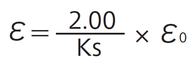
where, ε0: Measured strain
Ks: Gage factor of strain gage
Compensation Methods of Nonlinearity Error of Quarter-bridge System
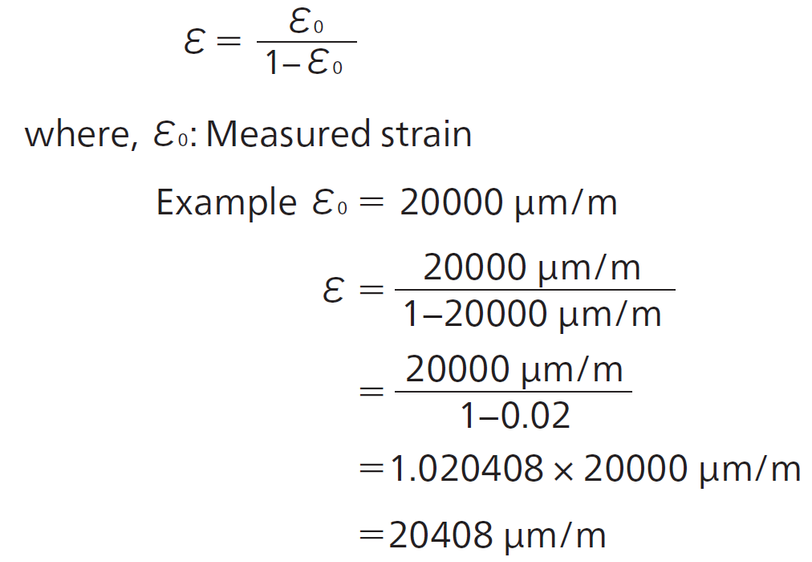
An error of nonlinearity in high-elongation strain measurement with quarter-bridge system is found by calculating true strain ε in the following equation:
An error of nonlinearity in high-elongation strain measurement with quarter-bridge system is found by calculating true strain ε in the following equation:
Compensation Methods of Effect of Lead Wire Extension
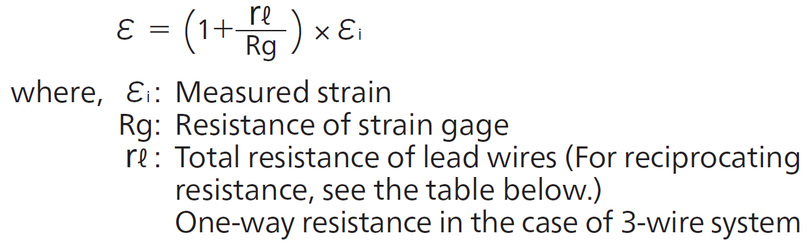
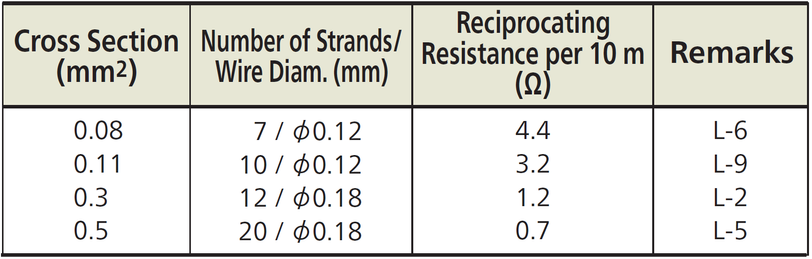
If the lead wire or cable is extended with the quarter-bridge or half-bridge system, additional resistance is initiated in series to the strain gage, thereby decreasing the apparent gage factor. For example, if a 10 m long lead wire with 0.3 mm2 conductors is used, the gage factor decreases by 1%. In the case of the full-bridge system (transducer), the extension decreases the excitation voltage too. In these cases, the real strain ε is obtained by the following equation. (Supposing the gage factor Ks is 2.00):
If the lead wire or cable is extended with the quarter-bridge or half-bridge system, additional resistance is initiated in series to the strain gage, thereby decreasing the apparent gage factor. For example, if a 10 m long lead wire with 0.3 mm2 conductors is used, the gage factor decreases by 1%. In the case of the full-bridge system (transducer), the extension decreases the excitation voltage too. In these cases, the real strain ε is obtained by the following equation. (Supposing the gage factor Ks is 2.00):
เราใช้คุกกี้เพื่อปรับปรุงไซต์ของเราและประสบการณ์ของคุณ อ่านเพิ่มเติมได้ที่ นโยบายความเป็นส่วนตัว